 openspp.org
Hazard management overview
Contents
Hazard management overview#
This guide is for implementers configuring hazard and disaster management in OpenSPP. You should understand your emergency response framework but don't need programming knowledge.
Mental model#
Hazard management in OpenSPP has four layers:
Layer |
What it does |
Example |
|---|---|---|
Category |
Classifies the type of hazard |
Natural → Storm → Typhoon |
Incident |
Records a specific disaster event |
"Typhoon Rai - Dec 2025" |
Impact |
Tracks how individuals are affected |
"Household displaced, property damaged" |
Geofence |
Defines the geographic response area |
Affected municipalities |
Think of it like a disaster response playbook: categories are the hazard types you prepare for, incidents are the events that actually happen, impacts are the damage assessments, and geofences are the response zones.
Key concepts#
Hazard categories#
Categories form a hierarchy for classifying hazard types:
Field |
What it means |
|---|---|
Name |
Category label (e.g., "Typhoon") |
Code |
Unique identifier |
Parent |
Parent category in the hierarchy |
Example hierarchy:
Natural Hazards
├── Geological
│   ├── Earthquake
│   └── Volcanic Eruption
├── Hydrometeorological
│   ├── Flood
│   ├── Typhoon
│   └── Drought
└── Biological
    ├── Epidemic
    └── Pest Infestation
Hazard incidents#
An incident records a specific disaster event:
Field |
What it means |
|---|---|
Name |
Incident label (e.g., "Typhoon Rai - Visayas") |
Category |
Type of hazard |
Start Date |
When the event began |
End Date |
When the event ended (if applicable) |
Status |
Current phase of response |
Severity |
Impact level (1-5 scale) |
Affected Areas |
Geographic areas impacted |
Incident status lifecycle#
Alert → Active → Recovery → Closed
Status |
Meaning |
|---|---|
Alert |
Hazard warning issued, preparing response |
Active |
Disaster is ongoing, response in progress |
Recovery |
Immediate threat passed, recovery operations |
Closed |
Response completed |
Severity levels#
Level |
Label |
Description |
|---|---|---|
1 |
Minor |
Localized damage, few affected |
2 |
Moderate |
Significant damage, hundreds affected |
3 |
Significant |
Widespread damage, thousands affected |
4 |
Severe |
Regional impact, tens of thousands affected |
5 |
Catastrophic |
National impact, mass displacement |
Impact types#
Impact types categorize how registrants are affected. OpenSPP includes 14 pre-configured types across four domains:
Domain |
Impact Types |
|---|---|
Physical |
Displacement, Property Damage, Injury, Death |
Economic |
Livelihood Loss, Asset Destruction, Crop Loss, Livestock Loss |
Health |
Illness, Disability, Psychological Impact |
Social |
Family Separation, Community Disruption, Education Disruption |
Impact records#
For each affected registrant:
Field |
What it means |
|---|---|
Registrant |
Who is affected |
Incident |
Which disaster |
Impact Types |
What kinds of damage |
Severity |
Individual impact level |
Notes |
Additional details |
Navigation#
Menu |
Purpose |
|---|---|
Hazard Categories |
Define hazard classification hierarchy |
Hazard Incidents |
Create and manage disaster events |
Hazard Impacts |
View individual impact records |
Geofences |
Define geographic response areas |
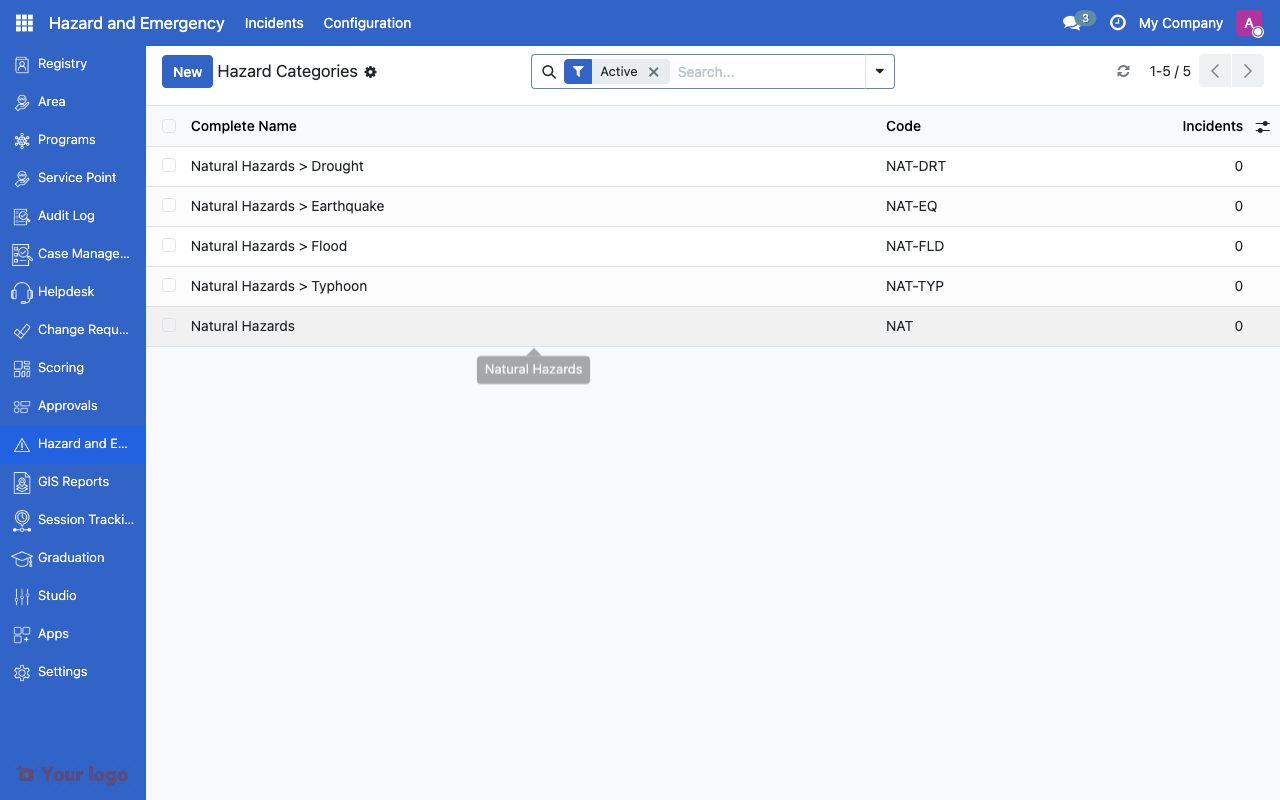
Hazard categories showing hierarchical classification.#
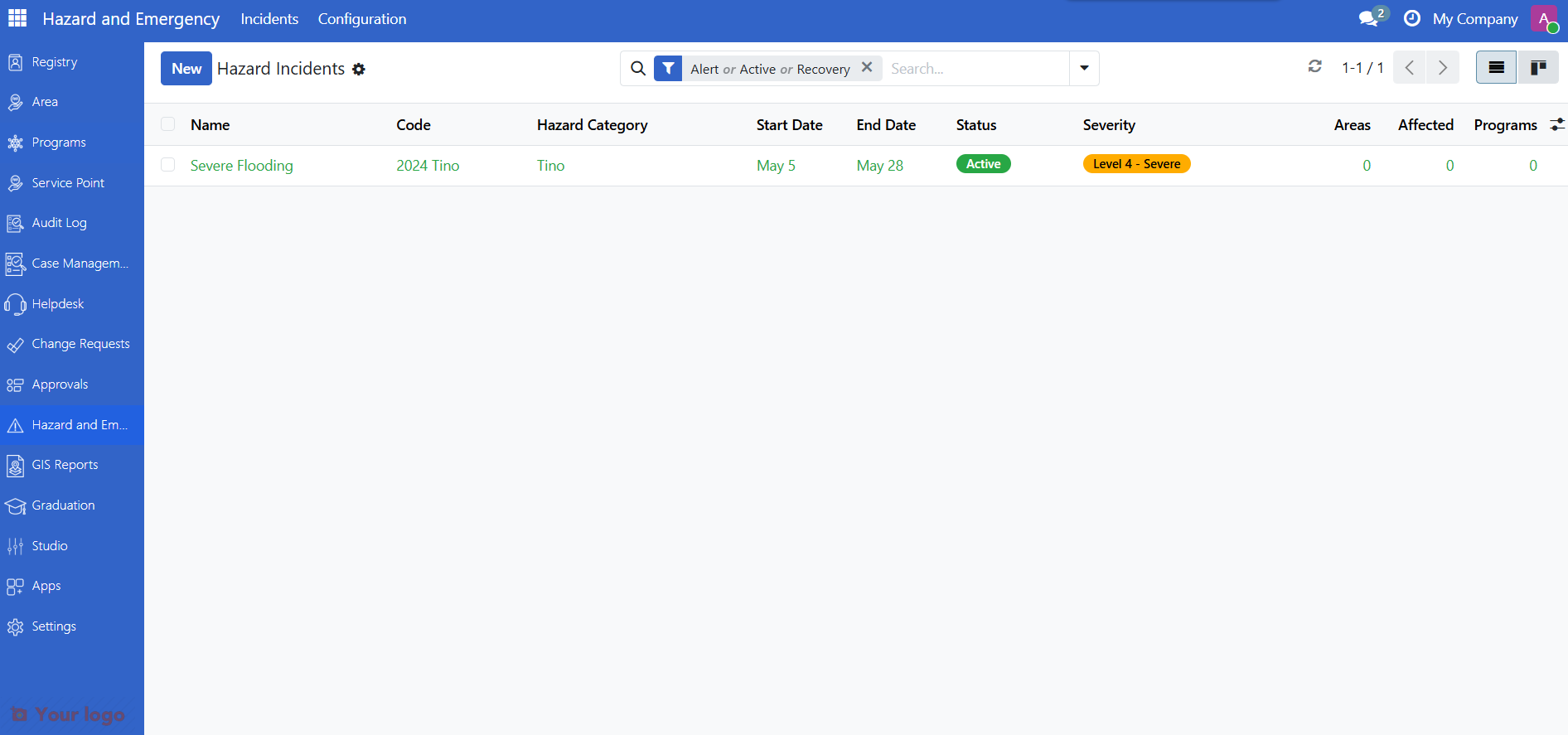
Hazard incidents list showing status and severity.#
Common use cases#
Use case 1: Typhoon response#
Goal: Set up tracking for a typhoon emergency.
Setup:
Create a Hazard Incident with category = Typhoon, severity = 4
Set affected areas (provinces/municipalities)
As assessments come in, create impact records for affected households
Link emergency cash transfer programs (see Linking programs to hazard incidents)
Use case 2: Drought early warning#
Goal: Track a developing drought for proactive response.
Setup:
Create a Hazard Incident with category = Drought, status = Alert
Set affected agricultural areas
Record crop loss impacts as reports come in
Escalate to Active when thresholds are met
Are You Stuck?#
Where do I configure hazard categories?
Look for Hazard Categories in the configuration menu. If you don't see it, ask your administrator to install the Hazard Management module.
Can I modify the pre-configured impact types?
Yes. Impact types are standard records that can be edited, deactivated, or extended with new types.
How do I track the same registrant across multiple incidents?
Each impact record links a registrant to a specific incident. A registrant can have impact records from multiple incidents, allowing you to track cumulative disaster exposure.
Severity levels - can I customize the scale?
The 1-5 scale is fixed, but you can define what each level means for your context through operational guidelines.
Next steps#
Linking programs to hazard incidents - Link programs to hazard incidents
Area management overview - Configure areas for incident mapping
GIS configuration overview - Visualize incidents on maps